


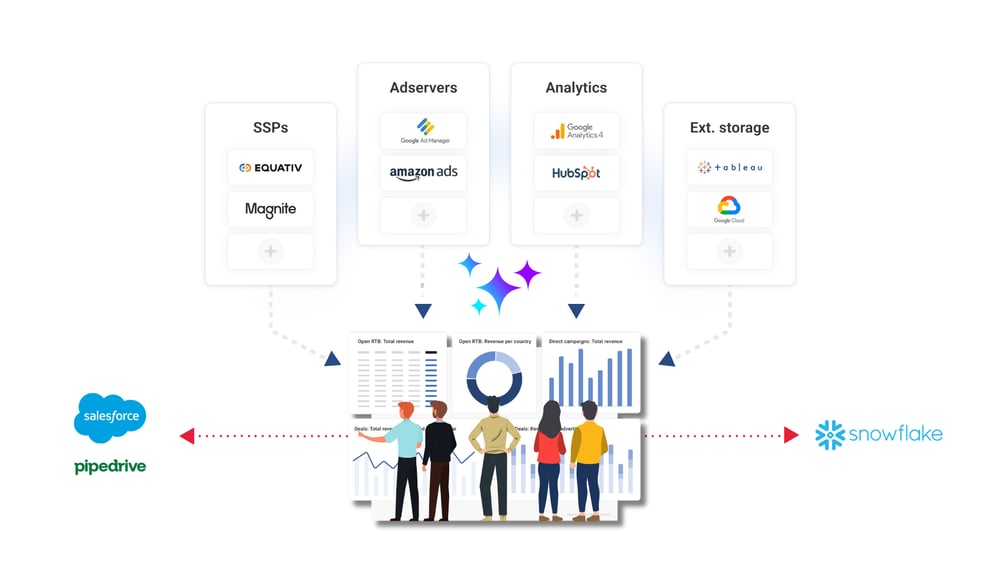
Ad monetization generates more data than ever before. With direct campaigns, SSPs, PMP deals, private marketplace agreements, and multiple programmatic channels, publishers have access to vast amounts of information about their advertising business. Yet surprisingly simple questions can still be difficult to answer. How much revenue came from direct campaigns last month? Which SSP is growing the fastest? Which advertisers have increased their spend? Which ad formats offer the greatest growth potential?
The required data usually already exists. The challenge is that it is scattered across different systems, defined in different ways, and is often difficult to access for those who need it most. Meanwhile, the business does not wait. Revenue declines, sales opportunities, and optimization needs require quick action. When answers take too long to find, the business suffers.
Why Doesn't Data Turn Into Decisions?
The challenge is that data resides across multiple systems, each using its own metrics, reporting models, and data definitions. Even between two data sources, there can be differences in how the same KPIs are defined and reported. Seemingly identical numbers may not actually represent the same thing. Is an impression really the same across every system? What about revenue or fill rate? For this reason, combining data is not simply a matter of bringing reports into a single view. Before data can be used for decision-making, it must be harmonized so that the same metrics mean the same thing regardless of their source. Only then can the data serve as a reliable foundation for decision-making.
Many publishers assume the work is done once the integrations have been built. In reality, that is only the beginning. Connecting one or two data sources is often relatively straightforward, but as reporting expands to include dozens of sources, the workload grows rapidly. Data sources evolve, new metrics are introduced, and reporting practices change continuously. The more data sources are added, the more maintenance, quality assurance, and ongoing development work are required. Much of this effort remains invisible to end users, even though it is precisely what makes long-term reporting reliable and trustworthy.
Data Creates No Value If It Cannot Be Used
Even if data has been collected, harmonized, and stored, it provides little value if the right people cannot access it. In many organizations, ad revenue data is still controlled by a small group of technical users. When a salesperson, account manager, or monetization specialist needs an answer, they often have to request a report or wait for assistance from a data expert. This slows the process and creates bottlenecks throughout the organization.
The highest cost is not the time spent building reports. The hidden cost is the optimization that never happened. It is the revenue decline that went unnoticed. It is the opportunity that was never identified. Experienced AdOps, RevOps, and sales teams create the most value when they can spend their time optimizing and making decisions rather than gathering data.
The Real Goal: Turning Data Into Decisions
Centralizing ad revenue data is not an end in itself. Its purpose is to enable better business decisions. A report showing that ad revenue has declined by 10% does not solve anything on its own. Value is created only when you understand why it happened, which inventory was affected, and what actions should be taken next.
The true cost of fragmented data is not only the effort required to maintain it, but also the opportunities missed and the decisions made too late. As publisher monetization strategies become increasingly sophisticated, the winners will be those who can turn trusted data into decisions — and decisions into action — fast enough. That is why centralized, harmonized, and easily accessible ad revenue data is no longer just an operational improvement. It is a competitive advantage. In practice, this means bringing every revenue source into a single revenue dashboard, where direct, programmatic and deal revenue can be compared side by side.
Read more: Understanding Ad Revenue Performance Through Dimensions and Metrics and JP/Politikens Hus Improved Advertising Reporting With Relevant Yield.
At Relevant Digital, we built Relevant Yield's Ad Revenue Insights with exactly this goal in mind. Through more than 80 data source integrations, fragmented ad revenue data can be harmonized and combined into a single view, allowing teams to spend less time gathering information and more time using it. Relevant AI takes this one step further. Instead of searching through reports for answers, users can simply ask questions in natural language. As a result, data turns into insights faster, and insights turn into concrete actions.

AdTech expertise for digital publishers
About Relevant Digital
Written by the AdTech experts at Relevant Digital. We help digital publishers manage, analyze and grow their advertising revenue with the Relevant Yield platform and dedicated expert support.